Why Price, Positioning, Presentation and Marketing Must Work Together
One of the most important decisions a seller will make happens before their home ever reaches the market: the price.
For luxury, waterfront, acreage and other unique properties in North Idaho, determining that price is much more complicated than looking at an automated home value, averaging the price per square foot of nearby sales, or choosing a number based on what another seller is asking.
My approach is different.
I use detailed comparable analysis, appraisal-style adjustments, current and historical competition, buyer behavior and property-specific characteristics to establish a supportable range of value.
Then we determine how to strategically position the property within the market.
Those are two different things.
Value is what the evidence supports. Price is part of the strategy we use to sell the property.
That distinction has been extremely important in North Idaho's luxury and waterfront markets, where correctly positioned properties can attract strong early interest, fast offers and, under the right circumstances, multiple buyers.
But pricing is only one part of the equation.
I continually train our agents at Lifestyle North Realty Group around four components that I believe have to work together for a listing to succeed:
Price. Positioning. Presentation. Marketing.
If one of those is substantially wrong, it can negatively affect everything else.
My goal isn't simply to put another listing on the market.
It is to accurately evaluate the property, create the right strategy, attract qualified buyers, negotiate from a position of strength and successfully manage the transaction all the way to closing.
Why Pricing North Idaho Luxury Real Estate Is Different
There really isn't one "North Idaho real estate market."
Coeur d'Alene, Hayden, Post Falls, Rathdrum, Sandpoint and the surrounding communities contain dramatically different property types and buyer pools.
Even within the luxury market, a $2 million home near downtown Coeur d'Alene doesn't necessarily compete with a $2 million acreage estate outside Post Falls.
A home within a luxury golf community can have a completely different valuation profile than a similarly sized home outside the community.
Waterfront requires another level of analysis altogether.
A home on Lake Coeur d'Alene cannot simply be compared to every other waterfront property in Kootenai County. Hayden Lake, the Spokane River, Lake Pend Oreille and Priest Lake each have their own markets.
Even different locations on the same lake can command substantially different values.
That is why I don't believe broad averages should be used to determine the value of an individual luxury or waterfront property.
What the 2026 North Idaho Market Is Telling Us
The first half of 2026 illustrates why understanding the underlying market matters.
Kootenai County recorded approximately 1,707 residential sales during the first six months of 2026, an increase of about 5.8% from the same period in 2025. Total residential sales volume increased nearly 22%, reaching approximately $1.322 billion.
Waterfront tells an even more interesting story.
Kootenai County residential waterfront transactions actually declined from 40 sales during the first half of 2025 to 29 during the first half of 2026.
Yet total waterfront sales volume increased from approximately $73.3 million to $76.4 million.
The average waterfront sale price increased from approximately $1.83 million to approximately $2.63 million.
Does that mean every waterfront property in Kootenai County suddenly appreciated more than 40%?
No.
It means the composition of what sold changed.
That distinction is extremely important.
It is one of the reasons I am cautious when someone uses a broad market statistic to establish the value of one particular luxury property.
Luxury Buyers Are Buying, But They Are Selective
The luxury market provides another important lesson.
Through May 2026, Coeur d'Alene sales between $1 million and $1.999 million increased approximately 42% year over year. Activity at $2 million and above also increased significantly.
Yet average days on market in Coeur d'Alene increased from approximately 87 days to 116 days.
Those two things can happen simultaneously.
Luxury buyers can be active while overpriced or poorly positioned homes sit on the market.
Buyers at this level have choices.
They compare properties.
They study price histories.
They notice days on market.
They understand location, condition and amenities.
And increasingly, they have access to enormous amounts of information before they ever contact an agent.
A strong luxury market does not mean every luxury home will sell quickly.
It means there are buyers willing to purchase the right properties when they perceive the right value.
There Is No Standard "Price Per Square Foot" for Waterfront
Waterfront is where valuation becomes particularly complex.
When I evaluate a North Idaho waterfront property, I look far beyond the house itself.
Depending on the property, my analysis may include:
- Body of water
- Specific location on the lake
- Linear feet of waterfront
- Usability of the shoreline
- Sandy, pebble or rocky beach
- Water depth
- Dock size, condition and configuration
- Boat lifts and waterfront improvements
- Southern, western, eastern or northern exposure
- Sunset or sunrise orientation
- View corridor
- Privacy
- Neighboring properties
- Road and year-round access
- Lot size and topography
- Elevation above the water
- Ease of access from the house to the waterfront
- Home size and functionality
- Construction quality
- Age and effective age
- Remodel quality
- Garages and shops
- Guest homes and additional structures
- Outdoor living areas
- Landscaping
- Utilities and infrastructure
This is why two 4,000-square-foot waterfront homes can have dramatically different values.
One might have 75 feet of steep shoreline, numerous stairs and shallow water.
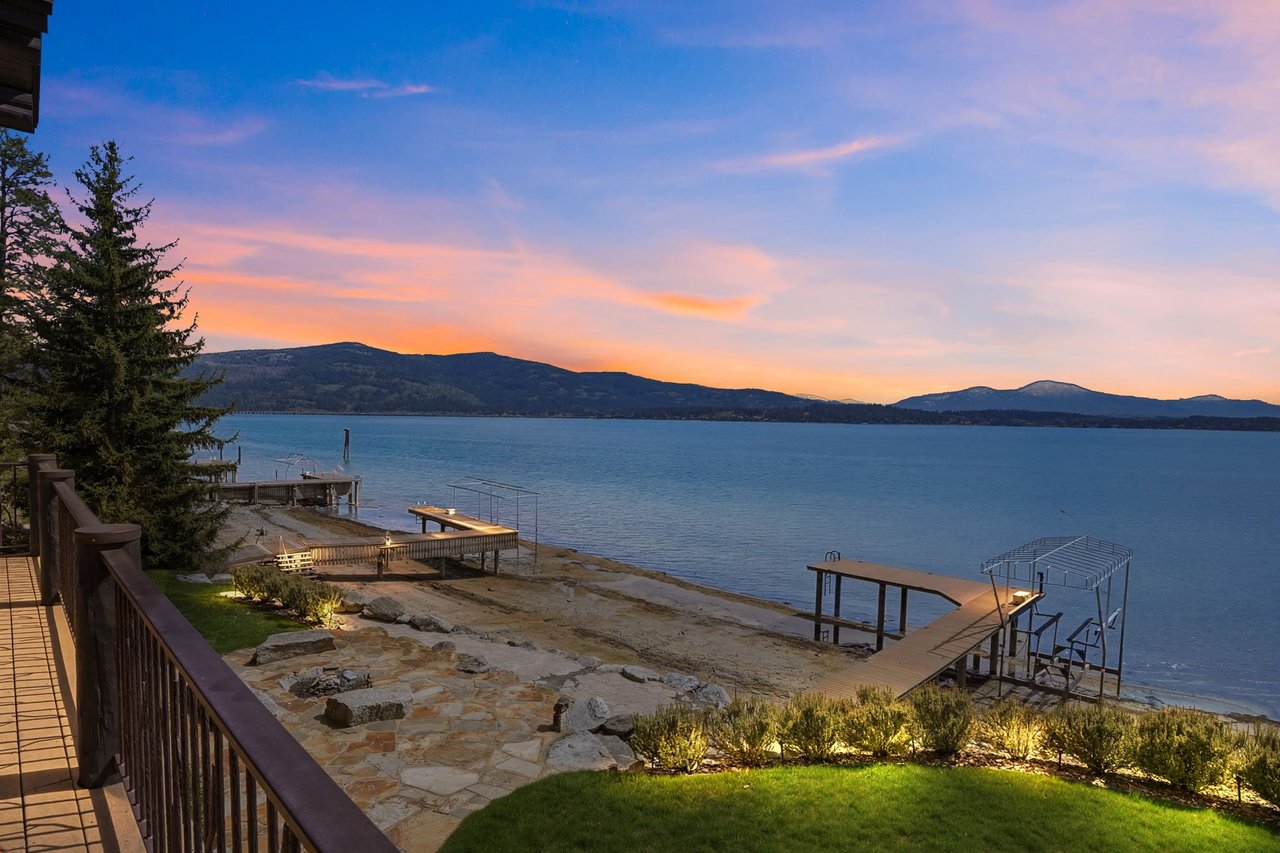
Another might have 200 feet of usable frontage, a sandy beach, deep water, a substantial dock and western exposure with incredible sunsets.
Those properties aren't comparable simply because the houses are similar in size.
The buyer isn't just purchasing square footage.
They are purchasing the property, the water and the lifestyle.
My Pricing Process Uses Appraisal-Style Adjustments
When I prepare a pricing analysis for a luxury, waterfront, acreage or otherwise unique North Idaho property, I use many of the same valuation principles used in a professional appraisal.
First, I identify the most relevant closed sales.
Then I analyze how those properties differ from the subject property.
If a comparable has substantially more acreage, I account for that.
If our property has superior waterfront, views or dock improvements, I account for it.
If the comparable was completely remodeled and our property needs significant updating, that matters.
Garages, shops, guest houses, construction quality, effective age, condition, location, views, acreage and other characteristics can all materially affect value.
The purpose isn't to force every property into a formula.
The purpose is to answer a more important question:
Why did one property sell for more or less than another?
For highly unique properties, I may analyze several different groups of comparable sales because there may not be one perfect comparable.
Eventually, the adjusted data begins to establish a supportable range of value.
If a Seller Doesn't Agree With My Valuation, I Am Willing to Test It
This is something I do differently.
Sometimes I meet with a homeowner who believes their property is worth substantially more than my analysis indicates.
That's okay.
I don't expect a seller to simply take my word for it.
If a seller isn't comfortable with my valuation, I have offered to pay for an independent appraisal from a qualified third-party appraiser of the seller's choice, without requiring the seller to sign a listing agreement with me first.
I have done this four times within the past year.
In those cases, the independent appraisers' conclusions have been very close to the values I had already calculated through my own analysis.
To me, that matters.
I don't want someone to choose me because I told them the highest number.
I want them to choose me because the analysis makes sense and they trust the strategy.
And if my valuation is wrong, I would rather find out before either of us invests time and money putting the property on the market.
I Would Rather Prove the Value Than "Buy the Listing"
There is a practice in real estate sometimes referred to as "buying the listing."
An agent suggests an unrealistically high price because they know it is what the seller wants to hear.
The seller signs the listing agreement.
The property goes on the market.
And then the market delivers the real answer.
The home sits.
Showings decline.
Days on market accumulate.
Price reductions begin.
Eventually, the property may arrive at the value range the data supported in the beginning, but by then something extremely valuable has been lost:
The excitement and leverage of being a new listing.
I would rather have a difficult pricing conversation before we list than spend the next six months chasing the market afterward.
Sold Properties Establish Value. Active Properties Establish Competition.
Closed sales tell us what buyers have actually been willing to pay.
But active listings tell us what buyers can purchase instead of our property today.
Both matter.
Suppose my adjusted comparable analysis indicates a property's value is somewhere around $2.7 million to $2.9 million.
Then I look at the current market and discover three exceptional competing properties available between $2.75 million and $2.85 million.
That affects our strategy.
Because the buyer isn't evaluating our home in isolation.
They're opening their phone, looking at everything available within their price range, touring several properties and comparing them.
Before we go on the market, I want to understand exactly what those buyers are going to see.
I Also Study the Homes That Didn't Sell
Expired, withdrawn and substantially reduced listings can provide some of the most valuable market information.
Sometimes one of the most informative comparables is the home that didn't sell.
If several similar luxury properties entered the market at $3.2 million, sat for months, experienced multiple reductions and ultimately sold around $2.7 million, that history tells us something.
It shows us where previous sellers encountered buyer resistance.
Ignoring that information because we want our property to be worth $3.2 million doesn't change what buyers have demonstrated they are willing to pay.
The market eventually gives us an answer.
My objective is to understand that answer before we list.
An Appraisal Establishes Value. Then We Strategically Determine the List Price.
When we have a recent independent appraisal, I don't necessarily recommend listing the property at the exact appraised value.
Under the right market conditions, I may recommend positioning it slightly below the appraised value.
That sometimes surprises sellers.
But an appraisal and a listing price serve different purposes.
An appraisal is an independent opinion of market value.
A listing price is also a marketing tool.
For example, if an independent appraisal supports a value of $2,000,000, there may be a strategic advantage to entering the market at $1,975,000 rather than $2,100,000 or $2,200,000 simply to "see what happens."
We're not saying the property is worth less.
We're positioning it to encourage buyer engagement.
Instead of buyers thinking:
"Why are they asking so much for this house?"
I want qualified buyers thinking:
"I need to see this property."
I have used this strategy with luxury and waterfront listings where the result has been a fast offer or multiple interested buyers.
It doesn't guarantee multiple offers. No pricing strategy can guarantee what the market will do.
But when valuation, property quality, competition and market conditions align, strategic positioning can create urgency.
And urgency can change the negotiating dynamic.
Strategic Pricing Is Not Underpricing
This is an important distinction.
Strategic pricing is not underpricing. It is using price to create competition.
My responsibility is to protect my seller's equity.
The objective is not the highest initial asking price.
The objective is the strongest final result the market will support.
If we price a $2 million property at $2.3 million and eventually negotiate it down to $1.9 million after months on the market, what did that $2.3 million asking price actually accomplish?
Compare that with strategically positioning the property based on supportable value, generating significant interest and potentially creating competition between qualified buyers.
Those are two very different negotiating environments.
Why "Let's Start High and Come Down" Can Be Expensive
I frequently hear:
"We can always start high and reduce it later."
Technically, that's true.
Strategically, it can be expensive.
The first few weeks of a listing are incredibly important.
The property is new.
Buyers receive alerts.
Agents send it to clients.
Our marketing launches.
Social media begins circulating it.
Photography and video are fresh.
Relocation buyers discover it.
Other luxury agents notice it.
If buyers immediately perceive value, we have an opportunity to convert that attention into showings and offers.
If they perceive the home as significantly overpriced, we can waste the strongest marketing period the listing may ever have.
Eventually, the conversation changes from:
"Did you see that new waterfront listing?"
to:
"Why hasn't that house sold?"
There may be absolutely nothing wrong with the home.
But extended market time can create uncertainty.
Price Reductions Don't Completely Reset the Clock
Imagine a property that should realistically compete around $2.75 million but launches at $3.2 million.
After 60 days, it drops to $2.995 million.
Later, it drops to $2.85 million.
Eventually, it reaches $2.75 million.
Now it may finally be priced correctly.
But buyers don't necessarily see a brand-new $2.75 million listing.
They see a home that started at $3.2 million and hasn't sold.
That can give buyers negotiating leverage that didn't exist when the property first entered the market.
That is what I am trying to avoid.
"I'm Not in a Hurry to Sell"
There is another conversation I am very willing to have with a prospective seller, even when it means I don't get the listing.
I frequently hear variations of:
"I'm not in a hurry to sell."
"I don't really need to sell."
"I'm not selling for less than $X."
There is absolutely nothing wrong with any of those positions.
A homeowner doesn't have to sell.
There may be a financial, personal or emotional reason they need a certain number to make selling worthwhile.
Sometimes, after we look at the data, my advice is simply:
Maybe this isn't the right time for you to sell.
What I don't believe makes sense is turning a seller's desired number into a list price when the market data doesn't support it.
"I'm Not in a Hurry" Doesn't Change Market Value
Being willing to wait doesn't automatically make a property worth more.
Sometimes markets appreciate and eventually catch up to a seller's desired price.
Sometimes an unusually motivated buyer appears.
But those are possibilities, not strategies I recommend building a listing around.
There is also an opportunity cost to allowing a luxury property to sit on the market indefinitely.
Days on market accumulate.
The listing becomes familiar.
Buyers wonder why it hasn't sold.
Agents may begin assuming the seller isn't realistic.
And even after the price is eventually corrected, buyers may approach the property differently than they would have when it was new.
Being willing to wait indefinitely isn't the same thing as having a selling strategy.
"I Don't Need to Sell" May Mean You Shouldn't
If someone tells me they don't need to sell and would only move if they received substantially more than today's market supports, I don't argue with them.
They may simply not be a seller yet.
Maybe the better decision is to continue enjoying the property.
Maybe we revisit its value in six months or a year.
Maybe market conditions change.
Maybe something changes personally that makes selling more attractive.
There is no reason to force a real estate transaction when the seller's objectives and the market aren't aligned.
I would much rather tell someone that honestly than convince them to list a property I don't believe I can sell under their required terms.
"I'm Not Selling for Less Than X"
When a seller tells me they have a specific minimum number, I want to understand why.
Maybe they need a certain amount of equity for their next purchase.
Maybe they invested substantially in improvements.
Maybe a neighbor sold for that amount.
Maybe another agent told them their property was worth it.
Whatever the reason, we can analyze it.
But there is an important difference between what a seller needs to receive and what the market indicates the property is worth.
The market doesn't know how much money a seller needs for their next house.
It doesn't know how much they originally paid.
And it doesn't automatically return every dollar spent on an improvement.
Buyers compare the property with their alternatives and determine what it is worth to them.
My job is to determine where the evidence suggests those two sides are most likely to meet.
A Listing Is a Business Investment for the Agent, Too
There is another side of the listing process consumers don't always see.
Most real estate agents operate as independent business owners.
When I agree to list a property, I am also agreeing to make a business investment in that property before I earn a dollar.
Depending on the listing, that investment can include professional photography, video production, aerial imagery, digital advertising, print marketing, property content, social media campaigns, signage, staging consultation, technology, administrative support, agent outreach and many hours of professional time.
For luxury properties, that investment can amount to thousands of dollars.
And unlike many professional services, I generally don't get paid for those services upfront.
I get paid if the property sells and successfully closes.
That means I am investing my company's resources alongside my seller.
If my professional analysis tells me a property is worth approximately $2 million and the seller tells me they won't accept less than $2.5 million, I have to make a business decision too.
Does it make sense to invest thousands of dollars marketing a property that I don't believe the market will purchase under the seller's required terms?
For me, the answer is no.
I Am in the Business of Selling Homes, Not Collecting Listings
There is an important difference between having listings and selling listings.
My objective isn't to put a sign in someone's yard, add another property to my website and hope the market eventually catches up.
I am in the business of selling homes.
That doesn't mean I expect every property to sell immediately.
It doesn't mean there will never be a price adjustment.
And it doesn't mean I can predict exactly what a buyer will ultimately pay.
But there needs to be a reasonable strategy for getting from listing to closing.
If a seller has already decided that they will not respond to market feedback or consider a price within the range supported by the evidence, then we may simply not be ready to work together.
That's okay.
I would rather recognize that before either of us spends the time or money.
Sometimes Sellers Choose the Agent Who Gives Them the Highest Price
I have had situations where I presented my valuation, explained the comparable sales and recommended a pricing strategy, but another agent suggested a substantially higher listing price.
The seller chose the higher number.
I understand why.
If one person tells you your home is worth $2 million and another tells you it is worth $2.4 million, the second conversation certainly sounds more appealing.
But a higher suggested listing price doesn't create a higher market value.
I have watched some of those properties sit on the market, experience price reductions, expire or ultimately sell within the range of my original assessment, and sometimes below it after accumulating significant market time.
I have also had sellers call me after their listing with another agent expired.
At that point, we are often having essentially the same pricing conversation we had months earlier, except now the property has a listing history.
That is precisely what I am trying to prevent.
The Same Principles Guide Our Entire Team
These aren't principles I apply only to my personal listings.
They are principles I continually train and reinforce with the agents at Lifestyle North Realty Group.
We consider ourselves real estate advisors first.
Our responsibility isn't simply to agree with a client, enter a property into the MLS and hope someone buys it.
Our responsibility is to understand the property, understand the market, give professional advice and create a strategy that gives our client a reasonable opportunity to accomplish their objective.
Our team specializes in many different types of North Idaho real estate, including luxury homes, waterfront properties, acreage estates, equestrian and horse properties, golf and lifestyle communities, land, new construction, investment properties and traditional residential homes.
Each requires different knowledge.
The buyer for a Lake Coeur d'Alene waterfront estate is evaluating different things than the buyer of a 20-acre horse property.
A luxury golf community buyer has different priorities than someone purchasing acreage near Sandpoint.
Even within the luxury category, the competitive market changes dramatically based on location, property type, amenities and lifestyle.
Professional real estate representation cannot be one-size-fits-all.
We Are Not Willing to Take Every Listing
One principle I continually reinforce with our team is:
We do not have to take a listing simply because someone is willing to give it to us.
Sometimes the most professional advice we can give a homeowner is that we don't believe they should list yet.
Sometimes the price isn't supported.
Sometimes expectations aren't aligned with the market.
Sometimes the property isn't ready to be presented properly.
Sometimes the marketing strategy a seller is willing to approve isn't sufficient for the property.
And sometimes we simply aren't the right fit for one another.
That's okay.
We would rather decline a listing than accept one under circumstances where we don't believe we can properly execute the strategy.
Because for us, everything needs to align.
Price. Positioning. Presentation. Marketing.
These are the four components I continually teach our team to evaluate.
1. Price
The price needs to have a defensible relationship to market value, comparable sales and current competition.
That doesn't mean every home needs to be the cheapest property in its category.
It means we need to understand exactly where the property fits in the market and why.
2. Positioning
Price and positioning are related, but they aren't identical.
Positioning is how we want buyers to perceive the property relative to everything else available.
What makes this property different?
Who is the most likely buyer?
What lifestyle does it offer?
What are its strongest competitive advantages?
What other properties will buyers compare it against?
A home isn't "luxury" simply because someone puts an expensive price on it.
We have to identify what creates its premium and communicate that to the market.
3. Presentation
The way a property is presented can reinforce its value or undermine it.
Condition matters.
Photography matters.
Video matters.
Preparation and staging matter.
The first photograph matters.
The order of the photographs matters.
The property description matters.
For luxury and lifestyle real estate especially, presentation should communicate the experience of owning the property, not simply document its bedrooms and bathrooms.
If we're asking buyers to recognize premium value, the presentation has to support that value.
4. Marketing
Finally, we have to put the property in front of the right audience and give that audience a reason to engage.
Depending on the property, our marketing can include professional photography and video, aerial imagery, digital campaigns, social media, agent-to-agent exposure, direct buyer outreach, property-specific website content, search optimization, relocation marketing and exposure through our broader network.
Increasingly, it also means structuring our online content so that properties and our areas of expertise can be understood through both traditional search engines and emerging AI-driven search platforms.
But marketing cannot indefinitely compensate for problems with the other components.
Marketing cannot fix an unrealistic price.
Beautiful photography cannot overcome poor positioning.
The right price can underperform if the property is presented poorly.
And an incredible property cannot generate the response it deserves if the right buyers never discover it.
Everything has to work together.
When One Piece Is Wrong, the Listing Can Fail
This is the concept I want every agent on our team to understand:
Price + Positioning + Presentation + Marketing = Listing Strategy
If any one of those components is substantially out of alignment, it can affect the performance of the entire listing.
If several are wrong, the likelihood of failure increases.
A seller may have an incredible home and outstanding photography, but if it is priced hundreds of thousands of dollars above its competitive market, qualified buyers may never engage.
A home can be priced correctly but presented poorly, causing buyers to overlook it.
A beautifully presented property can be marketed to the wrong audience.
Or an agent can spend thousands of dollars promoting a property whose seller has already stated they won't accept a price anywhere near what the market supports.
Those aren't necessarily marketing problems.
They are strategy problems.
And spending more money on marketing isn't going to fix a fundamentally misaligned strategy.
Once We Launch, We Listen to the Market
Our analysis doesn't stop when the listing goes live.
That is when we begin receiving real-world data.
I watch showing activity, online engagement, buyer responses, agent feedback, new competing listings, price reductions, pending sales and closed sales.
If qualified buyers consistently tour our property but choose something else, I want to understand why.
If we receive significant online activity but very few showings, that tells us something.
If showings are strong but nobody is writing an offer, that tells us something too.
We separate factors we cannot change from factors we can.
We can't move the property to another lake.
We can't increase the acreage.
We can't change the neighboring property.
But we can control our positioning.
The market communicates with us. Our job is to listen.
Getting an Offer Is Only Half the Job
One of the biggest misconceptions about selling a luxury property is that the agent's job is finished when an offer arrives.
It isn't.
The goal isn't an accepted offer. The goal is a successful closing.
When an offer comes in, I evaluate much more than the purchase price.
We consider the buyer's financing or proof of funds, earnest money, contingencies, inspection terms, appraisal exposure, requested concessions, closing timeline and overall strength of the contract.
The highest offer isn't always the strongest offer.
A slightly lower offer with strong financial qualifications and cleaner terms may ultimately produce a better result than a higher offer filled with contingencies and unnecessary risk.
This becomes particularly important when we have multiple interested buyers.
Luxury, Waterfront and Acreage Transactions Can Be Complicated
North Idaho's distinctive properties frequently involve issues that aren't part of a typical subdivision transaction.
Depending on the property, we may be navigating docks and waterfront improvements, shoreline considerations, wells, septic systems, private roads, road maintenance agreements, surveys, easements, acreage, outbuildings, shops, guest residences, permits, inspections, appraisal issues, title matters, repair negotiations and financing requirements.
These details can become transaction problems if nobody is managing them.
That is why our process is systematic from contract through closing.
We track deadlines, documentation, inspections, repairs, appraisal requirements, title issues and communication so problems can be addressed early rather than becoming emergencies immediately before closing.
Our Goal Is to Make a Complicated Transaction Feel Simple
A successful luxury transaction can have dozens of moving pieces behind the scenes.
The seller shouldn't have to manage all of them.
Our responsibility is to coordinate the process, communicate clearly, anticipate issues and keep everyone moving toward the same objective.
That can include communication with the seller, buyer's agent, lender, title and escrow, inspectors, appraiser, contractors and other professionals involved in the transaction.
When something comes up, we address it.
The smoother the transaction appears to the client, the more work is often happening behind the scenes.
That's the point.
Professionalism Sometimes Means Saying No
There can be pressure in real estate to take every listing opportunity.
I don't believe that is the professional standard we should set for ourselves.
If we are going to call ourselves real estate advisors, we have to be willing to give professional advice even when that advice costs us business in the short term.
Sometimes that means telling a seller their property may be worth more than they thought.
Sometimes it means identifying valuable characteristics other agents overlooked.
Sometimes it means recommending a different strategy.
Sometimes it means paying for an independent appraisal to test my own valuation.
And sometimes it means saying:
"Based on what you're telling me, I don't think this is the right time for you to sell."
That is still professional advice.
I want our agents to build careers based on knowledge, credibility, judgment and results, not on how many listing agreements they can collect.
We are representing one of the largest financial assets many of our clients own.
That deserves more than simply agreeing on a price and putting a sign in the yard.
Everything Has to Align
When I take a listing, I want the seller and our team working toward the same objective.
We need agreement on the property's realistic market position.
We need a pricing strategy supported by evidence.
We need the property prepared and presented appropriately for its market.
We need marketing designed around the actual buyer.
And we need a seller who is genuinely prepared to sell if the market responds within the range the evidence supports.
When those pieces align, I can confidently put my time, my team's resources and our marketing investment behind the property.
Price. Positioning. Presentation. Marketing.
Everything has to work together.
Because our job isn't simply to list North Idaho real estate.
Our job is to advise our clients, create the right strategy, sell the property and successfully manage the transaction all the way to closing.
Thinking About Selling a Luxury, Waterfront or Unique North Idaho Property?
If you own a luxury home, Lake Coeur d'Alene waterfront property, Hayden Lake home, Spokane River property, acreage estate, equestrian property, golf community home or another distinctive North Idaho property, I believe your pricing and marketing strategy should be as specific as the property itself.
Because my objective isn't simply to put your home on the market.
It is to price it with intention, position it correctly, present it exceptionally, market it strategically and manage the transaction successfully all the way to the closing table.
Desiree Jones | REALTOR®
North Idaho Luxury, Waterfront & Lifestyle Real Estate
Lifestyle North Realty Group | Brokered by eXp Realty
Coeur d'Alene | Hayden | Post Falls | North Idaho
Market statistics referenced in this article are based on 2026 North Idaho residential market data. Luxury, waterfront and unique properties are highly individual. Market statistics, comparable market analyses and appraisals are opinions and indicators of value and do not guarantee a particular sale price, marketing time or outcome.